Burgess Park has some of the most beautiful piles of rubble this time of year!
Come and find out about them on a guided walk with the designer, James Hitchmough, on 8th August 2015, starting at 11am. Read on for details and links.
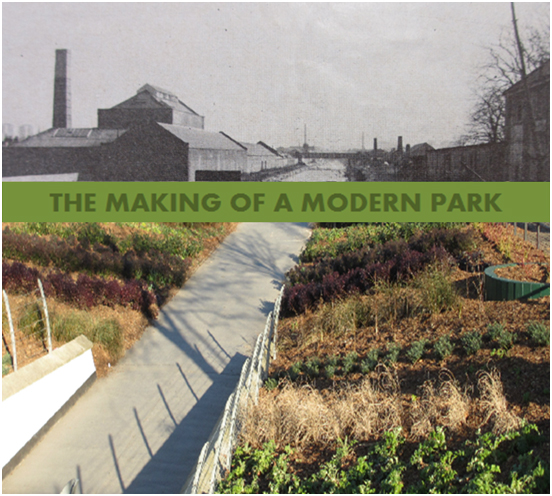
At the hand-over of Burgess Park from the GLC (at their dissolution in 1986) to Southwark Council, there were many buildings remaining in the park. In some cases, the GLC had plans for them, which were never realised due to their demise. In other cases, compulsory purchase had not been arranged yet, or there were long leases about to expire.
These buildings were nearly all eventually cleared by Southwark Council in the following ten years. In many cases, the rubble was simply piled up and topsoil dumped on top of it all. So various hillocks appeared wherever the buildings had happened to be.
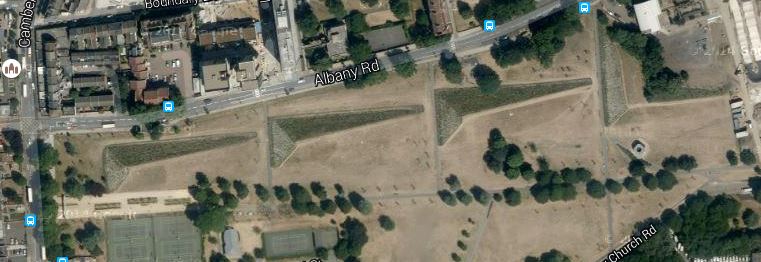
At the revitalisation stage in 2010, it was decided to make a feature of these hills by re-arranging them into a more meaningful formations.
The previous low plateaued hillocks became higher and steeper with ‘faces’ providing different climatic conditions to accommodate various kinds of planting.
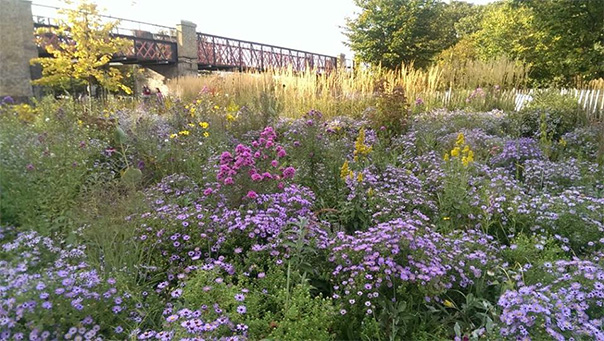
The designers, LDA, engaged the services of the Sheffield University Horticultural Department to plan the planting. James Hitchmough, celebrated for the London 2012 Olympic gardens, wildflower meadows and horticultural planting, devised meadow and prairie-like elements, and these were sown in January 2012.
New Hills at the western end in 2013
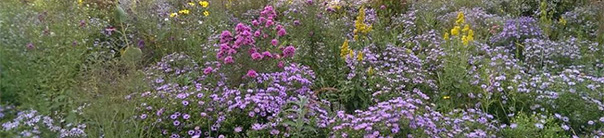
The north slopes comprise a ground layer of sown, shade-tolerant, mainly woodland perennials from which emerge summer and autumn flowering tall perennials. The West facing slopes support a heat and drought tolerant cosmopolitan meadow, running down to a drainage swale at the base. Despite some of the challenges, public response to the wildflowers has been extremely positive.
Professor Hitchmough will lead a walk explaining the design and planting, and describe how he arrived at the design. The walk will start at the western end, at the Tennis Courts near Addington Square, and visit the hills nearby. It will then move on to St Georges Gardens at the eastern side of the park, where he designed complex garden-like planting, which is looking beautiful now.
Please sign up for the walk on Eventbrite, where there will be a small deposit to pay, refundable on the day.
On 23rd May 2015, we followed up last year’s Bombs to BMX talk on the history of the the area by bringing the account of the making of the park almost up to date. Once again, we were privileged to have an auspicious line-up of guests, and the panel included some of the key players from the park’s growing years:
David Sadler MBE (former Burgess Park Manager) Joyce Bellamy OBE (GLC Parks Department) and Robert Hadfield (former vice-chair of Groundwork Southwark), chaired admirably by Barbara Pattinson (Chair of SE5 Forum)
David Sadler kicked things off in a relaxed style with his own memories of the challenges of running the park day to day. Metaphorically and literally down to earth stuff. He’d been Deputy Park Manager (working for the London County Council) for a few years in the 1960s and recalled helping plant some of the very first trees of what was then known as the “North Camberwell Open Space”. It would eventually be renamed Burgess Park – even though, as he later recounted, if the local schools had had their way, it would universally have been named Georgie Best Park.
Schools involvement was later a big part of his work – the nature area on Cobourg road for instance, where school groups were invited along to study wildlife reclaiming a bomb-site.
Having moved on to work in West Kensington, no less, it was a call from out of the blue that queued up a mystery promotion opportunity. It proved, of course, to be Burgess Park. Despite some friendly dismay (“why do you want to go there? it’s not even a park!?”), David returned to Camberwell, and the streets he’d known as a boy, now as Parks Manager. He would stay throughout the 70s, until the abolition of the GLC in 1986, when “we all found ourselves very suddenly out of a job”. But before then there were colourful stories of run-ins with the Richardsons on Neate Street, Cypriot festivals, discoveries of warehouses full of contraband whisky and even a proud turning point visit from the Duke of Edinburgh himself in 1985 – rudely derailed by the Brixton Riots.
Joyce Bellamy followed – always engaging, and once again on fine form. Joyce gave a very clear account of the painstaking piecemeal acquisition of land that went to build up the green space – over literally decades. She recalled the sheer scale of endeavour involved in decontaminating every inch of acquired ground – like the creosote contaminated ex-timber-yard plots. Over in Addington Square there’d been a scientific instrument makers, painting dials with glow-in the-dark paint, where “the soil in that area ticked when it was tested” [for radioactivity, with a Geiger counter]. The square, she noted as an aside, lacks tall trees in the centre to this day, because of the air raid shelter beneath it.
As ever Joyce displayed her usual knack for marrying big ideas to on-the-ground details, such as the local impact of the Civic Amenities Act, and recalling a later period “when the police had seemingly decided that all trees harbour muggers”. But her overarching tone was clear – one of quiet pleasure in seeing the park today blooming, and especially looking so well used.
Robert Hadfield, Joyce Bellamy, David Sadler (speaking, in front of a newpaper image of himself c.1980) and chair Barbara Pattinson (Photo: Sam Tilling)Robert Hadfield’s take reflected a later age, where grand visions were viewed a little more warily. Southwark Council had acquired the park rather suddenly in the mid 80s, and it seems initially nobody was quite sure what to do with it. Robert recalled with horror some of the dubious past plans (all thankfully fought off) to sell off plots of park land, noting in hindsight how they’d always occurred in June, July, & August when there were no Council meetings and the officers ran riot… There was almost a touch of W1A farce in some of the stories, including one of a war memorial being nicked, then spotted on the back of a lorry in east London and chased into the suburbs, later to be returned to its spot in front of St George’s church. On the surreal landscape of residual derelict buildings awaiting outright demolition, was the observation that they provided both hazard and resource alike – to eagle-eyed Robert on the lookout for a bit of skirting board or spare parts from the car-breakers’ yards.
But Robert’s overall theme was a cheerful reminder – that despite the highs and lows, and even the odd collective ghastly moment, the park always has been used and enjoyed by thousands, day-in day-out.
After a brief interval with refreshments and exhibition, the second half was given over to a lively audience question session. It was great to see a few familiar faces in the audience, such as Tim Charlesworth (author of “THE STORY OF BURGESS PARK – FROM AN INTRIGUING PAST TO A BRIGHT FUTURE”, and a memorable guest speaker last year), and the good folk of the Walworth Society.
We hope the supporting exhibition went down well – our thanks to Southwark Local History Library & Archive for permission to reproduce some of the images.
Finally a word of thanks to the Wells Way Pop-Up, who hosted us beautifully, providing seating and café.
Listen to Part 1 – presentations from the three speakers, following introductions from Susan Crisp – Friends of Burgess Park and Chair Barbara Pattinson – chair of SE5 Forum:
Wells Way Pop Up, The Old Library, 39 Wells Way, London SE5 OPX
The story of the post-war creation of Burgess Park, told by some of the prime instigators. A free Friends of Burges Park Heritage Event, as part of the Chelsea Fringe (donations gratefully received).
Come and join in the conversation with Joyce Bellamy, OBE, former head of parks for GLC, Dave Sadler, former park manager, Robert Hadfield, formerly with Groundwork.
The chat will be illustrated with images, maps, brochures and newsletters showing the development of the park from its WWII bomb site beginnings through the multi-million pound 2010 make-over to the present day.
There’ll be light refreshments available from the on-site cafe. This is a free Friends of Burgess Park Heritage Event, as part of the Chelsea Fringe festival (donations gratefully received).
Buses 343 and 136 (Elephant and Castle/Peckham/Lewisham) go almost to the door. Wells Way Pop Up is not fully accessible to wheelchair users: The access to the building is up 7 stone stairs and there are no level access toilet facilities in the building. If you can manage the entry steps and the steps to/from the basement level, we can assist with your access requirements.
Please help us plan for the day by registering on Eventbrite:
Southwark Council has decided that the original retaining wall of Glengall Wharf should be replaced with a concrete block barrier similar to those used on motorway embankments. Flowers and plants in the gaps will look ‘nice’, but effectively erase any idea of a canal bank.
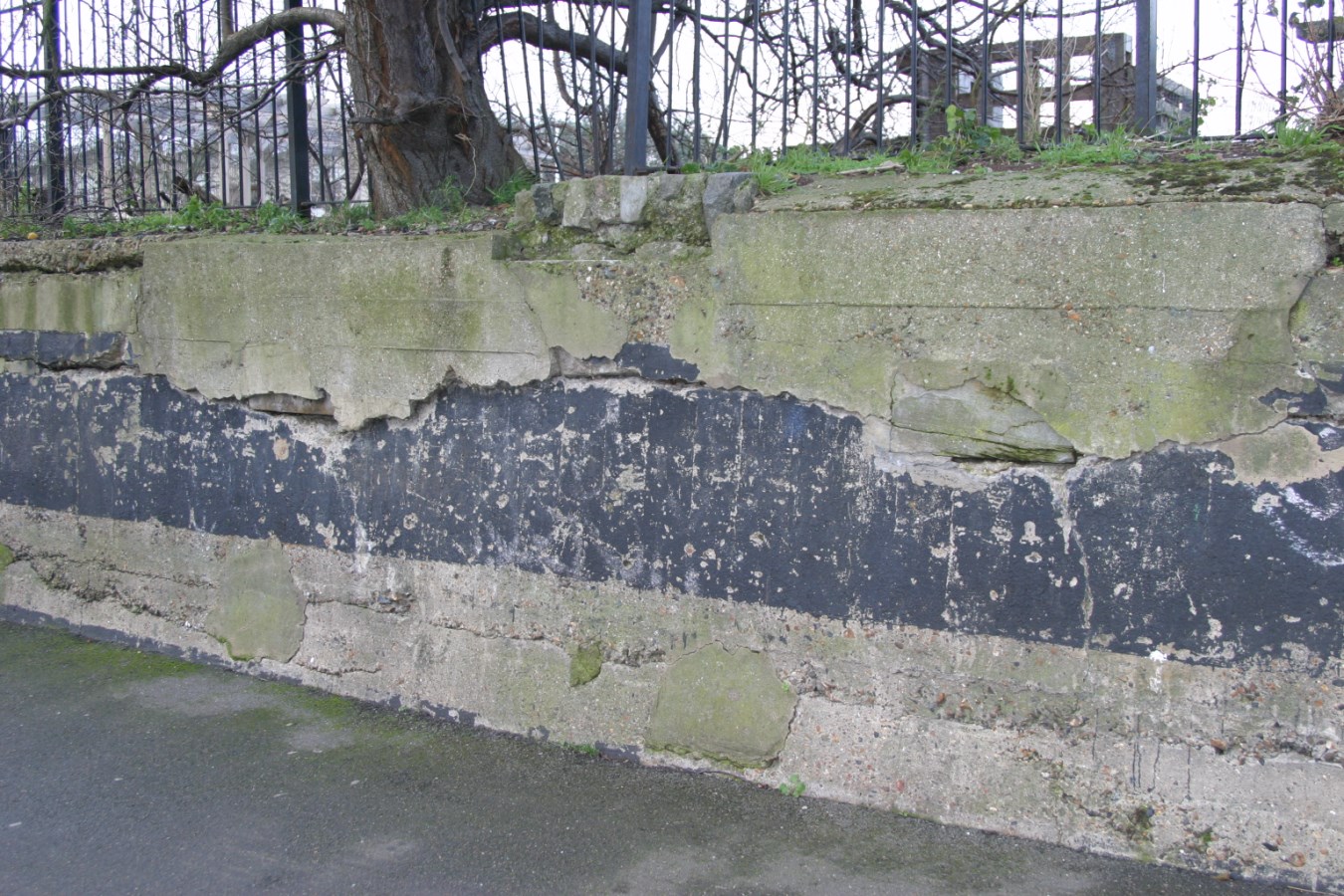
Original wall of Surrey Canal round Glengall Wharf
The existing wall is certainly not pretty, but it’s a major piece of industrial archaeology from the days when the canal ran alongside and turned down towards Peckham. Apart from the small low concrete ledge in the grass oppposite, it’s the only piece of original canal bank left on the entire three and a half mile length of the Grand Surrey Canal. It features in numerous historic photos of the area.
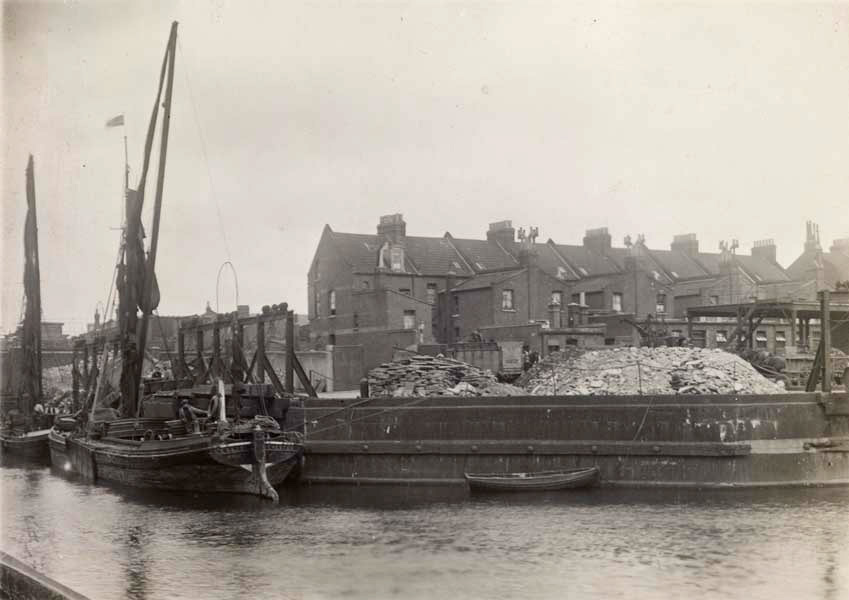
In this image, you can see the black painted wall with timber fenders attached part way down. In the present-day image above and below, the black painting is still visible, with plain concrete below, where the fenders had been attached.
Two stone blocks just visible, embedded in concrete
It’s also still possible to see large stone blocks embedded in the wall, if you take a walk today. These were the footings of the large loading chutes visible in the historic image. There are 12 visible on the Peckham route, corresponding to the 6 loading chutes which were on that side of Glengall Wharf.
It seems a great shame to bury almost the last signs of industrial canal heritage for the sake of a tidy-up.
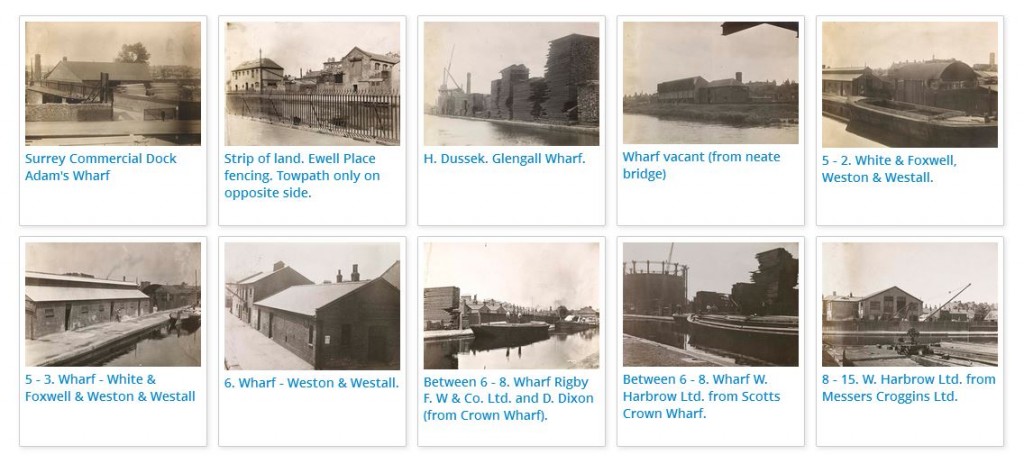
The Museum of London, in its role a keeper of the Port of London Authority archive, recently completed a project to gather information on a cache of 150 or so photographs of the Grand Surrey Canal. It’s thought these were taken between 1915 and 1925, and were attached to a notebook. They can be seen on the MOL site here.
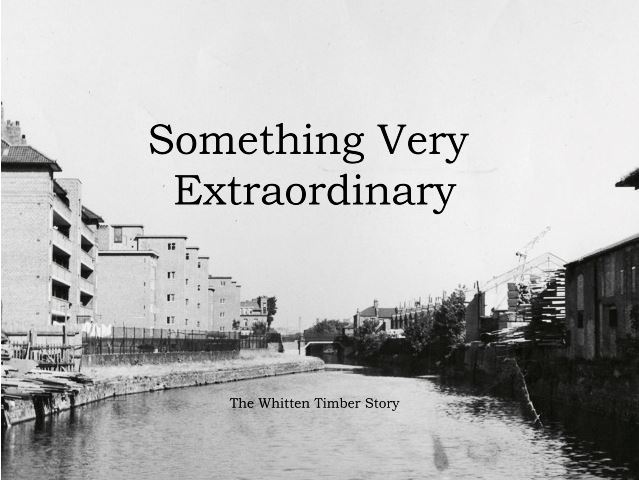
For a copy of the booklet shown here, or information on how the exhibition was put together, call in at Whitten’s Timber and ask for Jimmy.
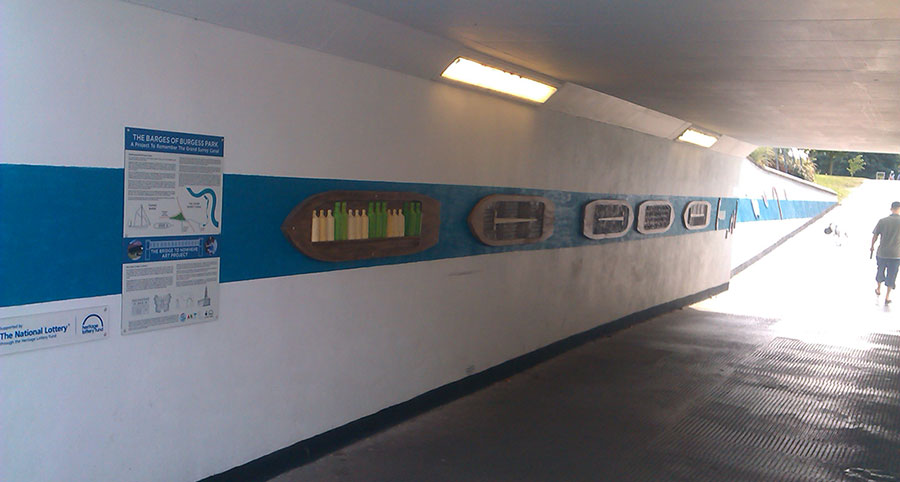
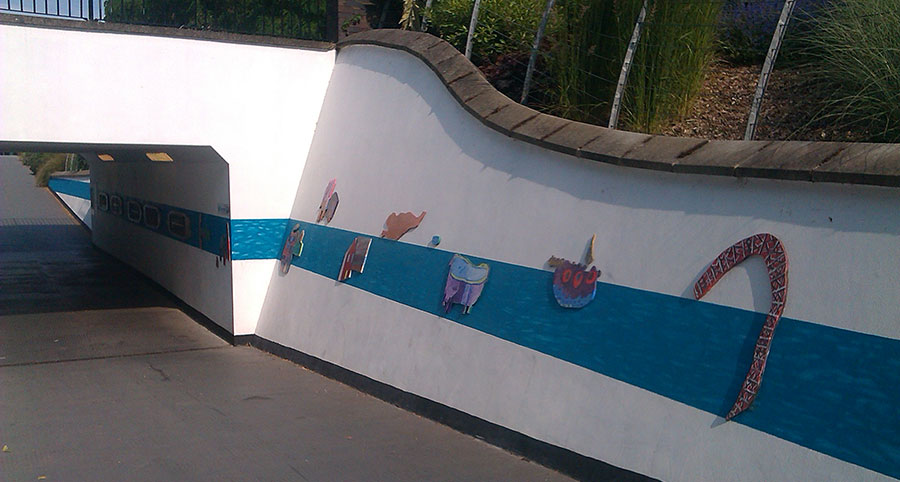
To celebrate the completion of our project we invited everyone who had been involved to come along for the grand “reveal” of the underpass installation and the launch of the heritage trail.
Underpass: Burgess Barges art Installation
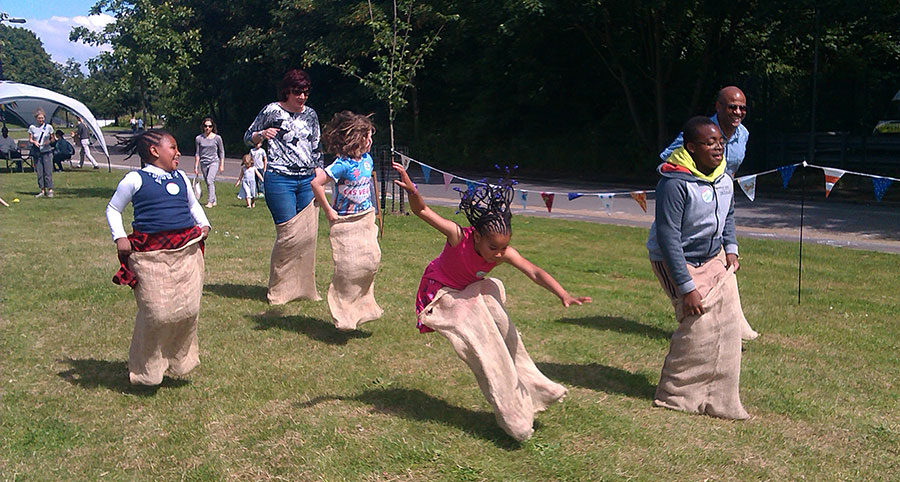
We had stalls and activities aimed at children as well as the promenade walk along the heritage trail.
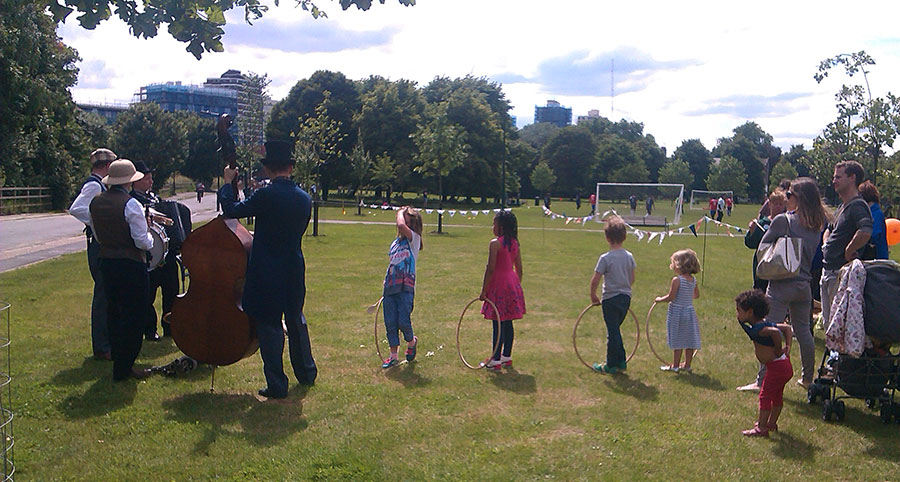
Families at the launch day
We were delighted that children who had taken part in the schools story-telling project and the Art in the Park workshops came along as well as people who had helped to make the heritage trail.
The entertainment at the launch: heritage band and hoop games.
We estimate about 300 came along and took part in the launch activities: children’s races, flag making, brick making, popcorn and lemonade stall and heritage stall displaying more materials. Plus, there were more people who stopped to examine our pop-up map exhibition hanging in the trees.
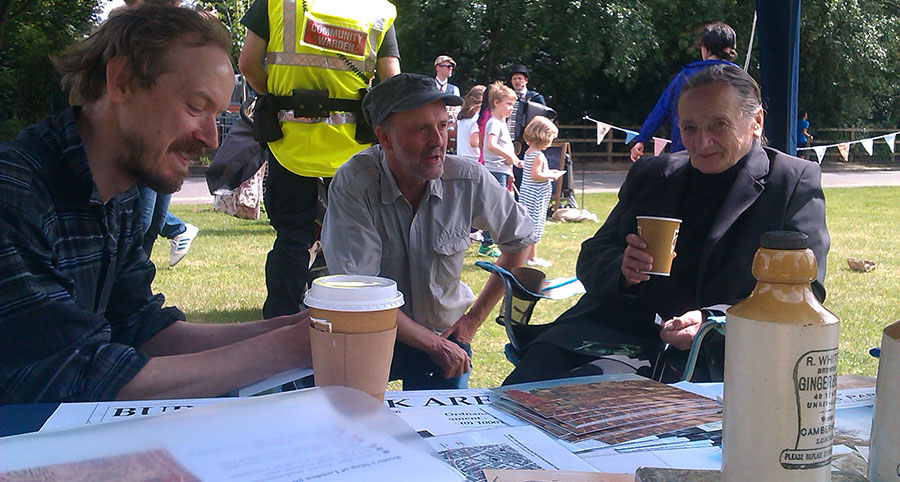
Friends of Burgess Park heritage stalwarts: Jon, Andrew and Joyce.
Thank you so much to everyone who took part. We couldn’t have completed this project without your enthusiasm, energy and expertise. Well done to all.
The Bridge to Nowhere heritage project continued apace in February, with a packed gathering, organised by the Friends of Burgess Park of locals, enthusiasts, and experts, all celebrating the park’s rich history together.
With fascinating talks delivered by our three leading published local historians – Stephen Humphrey, John Beasley and Tim Charlesworth – and a healthy hubbub of shared memories and stories, there was much to enjoy – not to mention photos, maps and refreshments.
The Friends are currently developing a heritage trail to be launched later this year, and would love to hear from you if you’re interested in getting involved.
The traditional craft workshops run by Friends of Burgess Park as part of their history project Bridge to Nowhere were greeted with such enthusiasm and a desire to learn craft skills especially knitting. The word got about and well over 30 people took part on the last day and the big question was “When will the next workshop be?”
Over three days, participants got the chance to try out traditional hand sewing, embroidery and knitting , and on the last day, to have a go at canal style art. Most of the people taking part were born long after the canal closed, but were interested to learn more about it through the art work reference materials.
Jowett Street Park sits next to what was a spur of the Grand Surrey Canal which ran to Peckham from the Surrey Docks. It was a lovely friendly setting for the event. We were blessed with great weather and the support of Quadron staff who brought along the tables and gazebo each day. We were also very grateful to The Sojourner Truth Centre who allowed use of their facilities. A big thank you to them and to all the hard working volunteers.
I moustache you a question.
Why all the moustaches?
To tell people the story about Burgess Park’s development from a built-up area that over 60 years has been transformed into the park. And the moustaches are for the heavily moustachioed and bearded characters from the past. And FUN for people when trying out our historical cutout characters. The moustaches and the characters first appeared at the May Fair where our project was launched.
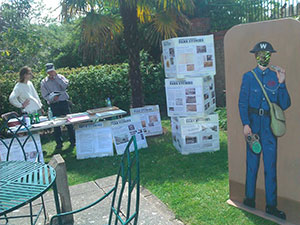
Friends of Burgess Park heritage stall
The Chumleigh Gardens Open Squares weekend 8/9 June 2013, saw the return of our temporary heritage trail, also excellent music from choirs to jazz, gardening in the heart garden, guided tours with the head gardener Mark Cox and a silkscreen bag printing workshop with Art in the Park. On Sunday Peckham Theatre came to visit Burgess Park for a fundraising walk.
Manage Cookie Consent
To provide the best experiences, we use technologies like cookies to store and/or access device information. Consenting to these technologies will allow us to process data such as browsing behaviour or unique IDs on this site. Not consenting or withdrawing consent, may adversely affect certain features and functions.
Functional
Always active
The technical storage or access is strictly necessary for the legitimate purpose of enabling the use of a specific service explicitly requested by the subscriber or user, or for the sole purpose of carrying out the transmission of a communication over an electronic communications network.
Preferences
The technical storage or access is necessary for the legitimate purpose of storing preferences that are not requested by the subscriber or user.
Statistics
The technical storage or access that is used exclusively for statistical purposes.The technical storage or access that is used exclusively for anonymous statistical purposes. Without a subpoena, voluntary compliance on the part of your Internet Service Provider, or additional records from a third party, information stored or retrieved for this purpose alone cannot usually be used to identify you.
Marketing
The technical storage or access is required to create user profiles to send advertising, or to track the user on a website or across several websites for similar marketing purposes.


![IMG_2026a [Desktop Resolution]](https://bridgetonowhere.friendsofburgesspark.org.uk/wp-content/uploads/IMG_2026a-Desktop-Resolution.jpg)
![Clearance [Desktop Resolution]](https://bridgetonowhere.friendsofburgesspark.org.uk/wp-content/uploads/Clearance-Desktop-Resolution-300x197.jpg)

![CFLogo2015_dates [Desktop Resolution]](https://bridgetonowhere.friendsofburgesspark.org.uk/wp-content/uploads/CFLogo2015_dates-Desktop-Resolution.jpg)